
Social Stock Exchange
THE SOCIAL STOCK EXCHANGE (SSE): A PRACTICAL GUIDE TO LISTING, ZCZP
FUNDRAISING, AND SEBI COMPLIANCE
Historically, India’s social sector has run on a mix of grants, corporate social responsibility (CSR) budgets, and traditional donations. But let’s be honest, for many NGOs, Trusts, and Section 8 companies, this funding model can feel like a hand-to-mouth existence. It lacks predictability, and getting access to serious, institutional capital is a constant uphill battle.
To bridge this gap, SEBI stepped in and introduced the Social Stock Exchange (SSE). Operating as a specialized segment under both the National Stock Exchange (NSE) and BSE Limited (BSE), the SSE is effectively trying to professionalize kindness. It treats social development not as an afterthought, but as a core financial sector that deserves transparency, regulatory backing, and long-term stability.
Why the Shift? Fixing the "Trust Gap"
There is no shortage of people or institutions willing to back social causes in India. The friction point has always been donor hesitation. Donors frequently wonder: Is my money actually reaching the ground, or is it getting swallowed up by administrative loops?
The SSE fixes this by replacing blind faith with market-grade accountability. Because it runs under SEBI’s watchful eye, listed organizations have to lay out clear project roadmaps, expose their financials, and routinely prove their ground-level impact.
Who Can Apply (And Who is Locked Out)?
The platform is open to two broad categories of organizations, provided their primary mission is creating measurable social impact:
- Non-Profit Organizations (NPOs): This includes Public Charitable Trusts, Registered Societies, and Section 8 Companies.
- For-Profit Social Enterprises (FPEs): Corporate entities that put social goals at the heart of their business model.
The Strict Red Lines
To protect the credibility of the platform, SEBI has completely blacklisted certain entities. You cannot register if you are a:
- Corporate foundation (the CSR wing of a commercial company).
- Political or religious organization.
- Trade or professional association.
- Infrastructure or housing firm (unless you are explicitly building affordable housing).
The Gateway Tests: Are You Ready to List?
Before you start drafting any paperwork, your organization must clear five baseline regulatory filters:
- The Legal Base: You must have a clean, valid registration as a Trust, Society, or Section 8 Company, including active tax certificates like 12A/12AB and a valid 80G registration (essential for giving tax benefits to donors) that is valid for at least the next 12 months.
- Track Record: You need a minimum of 3 years of active operational existence.
- Financial Scale: Generally, you must show an annual expenditure of at least ₹50 Lakhs and annual funding receipts of at least ₹10 Lakhs.
- The Social Focus List: Your core work must align with SEBI’s recognized social activities, ranging from poverty alleviation, healthcare, and education to women’s empowerment, rural sports, and bridging the digital divide. The Social Enterprise shall target underserved or less privileged population segments or regions recording lower performance in the development priorities of the Central or State Governments, or such other target segments as may be specified by the SEBI from time to time.
- The Critical “67% Rule”: This is the ultimate gatekeeper clause. You must prove that on a 3-year average, at least 67% of your activities, your operational expenditure, OR your target customer/beneficiary base is directly tied to serving underserved or less-privileged populations.
What is a ZCZP Instrument?
The core fundraising tool for NGOs on the exchange is the Zero Coupon Zero Principal (ZCZP) instrument.
If you are looking at this from a commercial perspective, the name sounds incredibly dry. But in plain English, it is a donation structured like a security.
- Zero Coupon means you pay 0% interest.
- Zero Principal means you never repay the core amount.
The contributor isn’t buying equity or making a loan; they are funding a specific social outcome. The ZCZP simply allows that transaction to happen securely through depository infrastructure (Demat and ISIN accounts), giving donors the exact same transparency they expect when buying regular corporate shares.
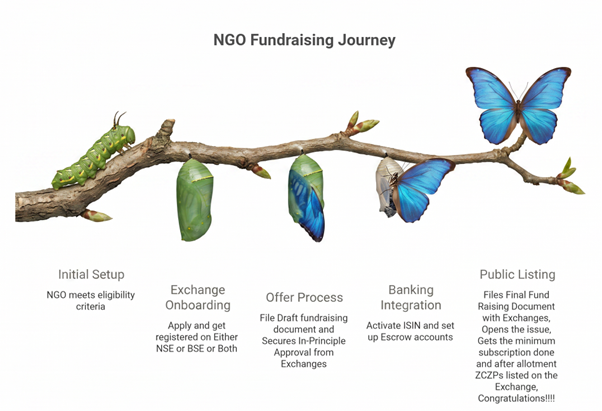
The Roadmap: Moving from Application to Listing
Taking an NGO public on the SSE involves a highly structured, multi-step execution pipeline:
The In-Issue Reality Check
When your ZCZP issue goes live, it behaves much like an IPO. Traditionally, a minimum 75% subscription was required for an issue to succeed.
Under the latest regulatory updates, SEBI has softened this stance to allow a 50% minimum threshold, but with a serious operational condition: the exchange will run strict due diligence beforehand to ensure your project remains completely viable and meaningful even if you only raise half the target capital. If you fail to hit even this lower threshold, the entire amount must be promptly refunded to the donors via the escrow mechanism.
Life after Listing: Post-Listing Compliances
Listing isn’t a one-time transaction; it’s a commitment to a new way of working. Once your organization is on the SSE, you enter a structured compliance routine:
- Annual Impact Reporting: You must submit a comprehensive disclosure detailing exactly what your project achieved.
- The Social Audit: This isn’t just an internal review. An independent, certified Social Auditor must evaluate your project implementation efficiency, beneficiary outcomes, and fund utilization to verify your claims.
- Material Disclosures: Any significant event that impacts your project’s execution or governance must be declared to the exchanges immediately.
Choosing Your Platform: NSE vs. BSE or Both
Both exchanges offer an exceptional, SEBI-regulated ecosystem, but they carry slightly different operational profiles:
- NSE SSE: Typically leverages a massive institutional investor footprint, offering broader corporate visibility and strong market recognition.
- BSE SSE: Offers an incredibly active, rapidly scaling social finance ecosystem with a highly structured, supportive compliance framework tailored for growing NGOs.
Many organizations consult with professional advisory services to handle the deep legal drafting of the Draft Fund Raising Document (DFRD), manage exchange queries, coordinate the banking escrow setups, and handle post-listing compliance.
The Bottom Line
The Social Stock Exchange is shifting the social sector away from uncoordinated philanthropy and toward institutional scale. For forward-thinking NGOs and Section 8 companies, clearing the entry bars and getting listed is more than just a capital play, it is the ultimate stamp of institutional credibility in India’s development ecosystem.Top of Form